


When knee pain begins to interfere with your daily life—whether it’s walking, climbing stairs, or sleeping at night—it may be time to consider surgery. But not all knee replacements are the same.
Difference between partial and full knee replacement
Understanding the difference between a partial and a total knee replacement can help you feel more confident in your treatment journey.
Partial Knee Replacement (PKR)
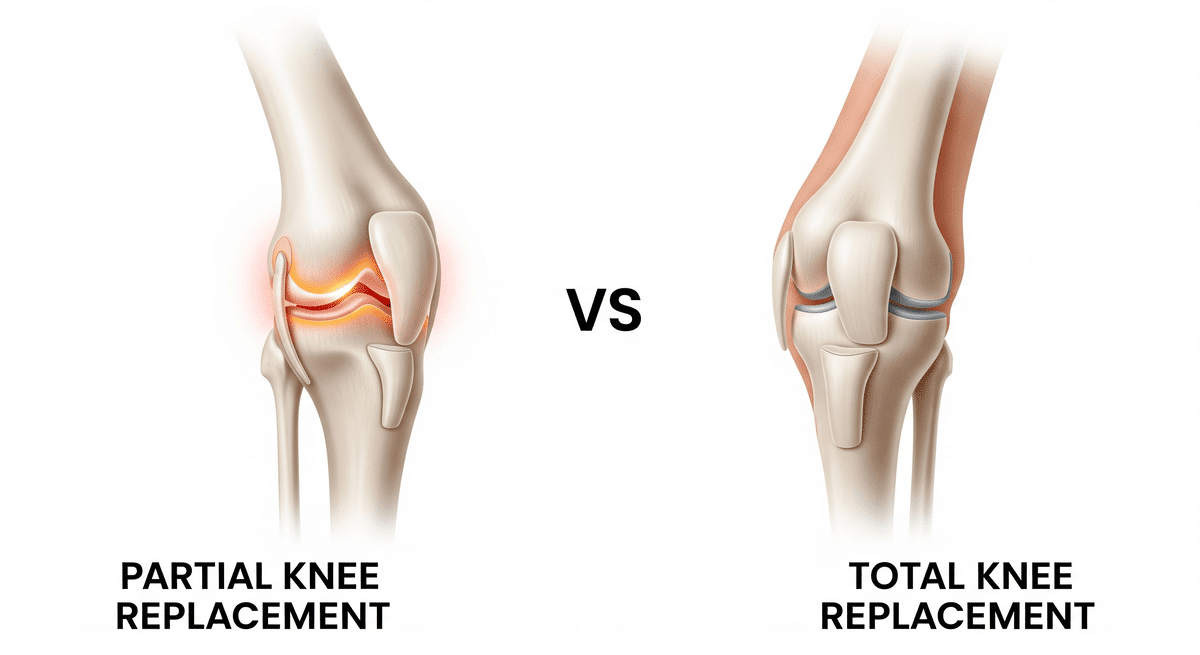
Also called unicompartmental knee replacement, this surgery is ideal when only one part of the knee joint is damaged—usually the inner (medial) side.
Benefits of Partial Knee Replacement:
- Smaller incision and quicker recovery
- Less blood loss
- More natural knee movement after surgery
- Often performed on younger, active patients
Total Knee Replacement (TKR)
A total knee replacement involves replacing all surfaces of the knee joint. It’s the best option when arthritis or damage affects multiple parts of the knee or when conservative treatment has failed.
Benefits of Total Knee Replacement:
- Long-lasting relief for moderate to severe arthritis
- Improved mobility and quality of life
- Suitable for patients with complex or long-standing joint issues
| Feature | Partial Knee Replacement (PKR) | Total Knee Replacement (TKR) |
|---|---|---|
| Also Known As | Unicompartmental Knee Replacement | Total Knee Arthroplasty |
| Area Treated | One compartment (usually medial/inner side) | All surfaces of the knee joint |
| Best Suited For | Younger, active patients with localized damage | Patients with widespread arthritis or complex joint issues |
| Incision Size | Smaller | Larger |
| Blood Loss | Less | More |
| Recovery Time | Faster | Longer |
| Knee Movement | More natural feel post-surgery | Improved mobility and stability |
| Longevity | Good, may require revision later | Long-lasting relief for severe arthritis |
Recovery Time: Partial vs Total Knee Replacement
When considering knee replacement surgery, recovery time is often one of the first questions patients ask — and rightfully so. The good news is that both procedures have well-established recovery timelines, so you can plan ahead with confidence.
Partial Knee Replacement Recovery
Because only one compartment of the knee is treated, the body has less healing to do. Most patients are up and walking with minimal assistance within a few days and can return to light daily activities in 3 to 6 weeks. The smaller incision also means less post-operative pain and a lower risk of complications, making the overall experience significantly smoother.
Total Knee Replacement Recovery
A total knee replacement is a more extensive procedure, and recovery reflects that. Patients typically begin walking with support within 24 hours of surgery, but a full return to normal activities usually takes 3 to 6 months. Physical therapy plays a major role in rebuilding strength and restoring range of motion during this period.
Always consult your orthopedic surgeon to determine which procedure aligns best with your condition and lifestyle goals.
Which Is Right for You?
If pain is isolated to one side of the knee → Partial may be a fit.
If pain affects the whole knee or has progressed → Total may be needed.
A physical exam, imaging, and your activity goals will help your orthopaedic surgeon guide the decision.
The good news? Both knee procedures are highly effective, and recovery plans can be tailored to your lifestyle.
Knee pain isn’t something you have to live with. The expert team at City Orthopaedics & Sports Medicine can help you find the right solution—whether it’s surgery or something less invasive.
Frequently Asked Questions
What is the difference between a partial and total knee replacement?
A partial knee replacement replaces only one part of the knee, while a total knee replacement involves resurfacing the entire joint. The choice depends on the extent of damage and your lifestyle. City Orthopaedics & Sports Medicine can help you decide the best option.
Who is a candidate for partial knee replacement?
Patients with arthritis or damage limited to one side of the knee, typically the inner side, may be good candidates for partial knee replacement. City Orthopaedics & Sports Medicine will assess your condition and recommend accordingly.
How long is the recovery after knee replacement surgery?
Partial knee replacement generally allows quicker recovery (4–6 weeks), while total knee replacement may take 8–12 weeks or more. City Orthopaedics & Sports Medicine creates personalized recovery plans to suit your needs.
Is knee replacement a permanent solution for arthritis?
While not permanent, both partial and total knee replacements can last 15–20 years or more. The team at City Orthopaedics & Sports Medicine focuses on long-term outcomes and patient satisfaction.
Ready to take the next step? Book a consultation with City Orthopaedics & Sports Medicine today.