

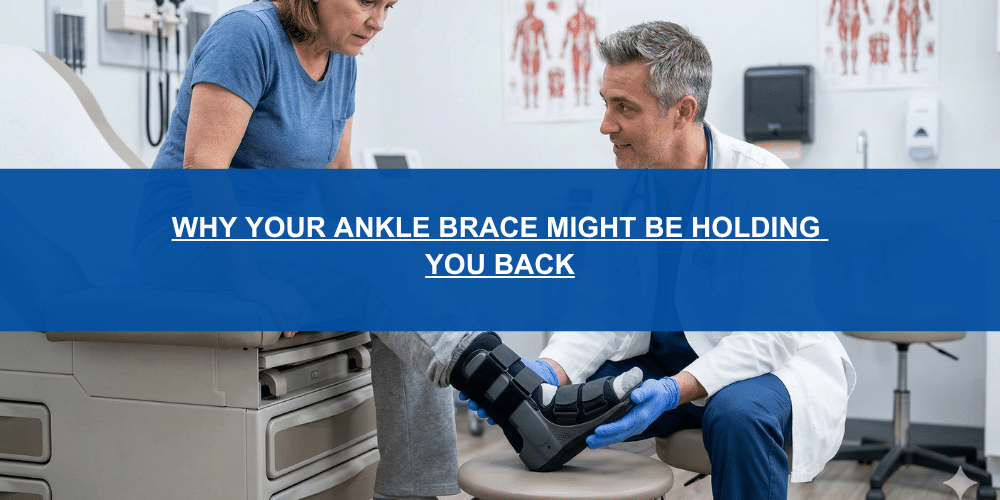
An ankle brace is supposed to protect you but what if the one you’re wearing right now is quietly working against you? If you’ve ever felt stiff, sluggish, or less agile while braced up, there’s a real clinical reason behind it. And you deserve to know what it is.
At City Orthopaedics Sports Medicine, patients come in every week athletes and everyday movers alike still dealing with recurring sprains, reduced mobility, or nagging discomfort despite faithfully wearing their brace. The issue often isn’t their ankle. It’s the brace itself.
The Hidden Problem With Traditional Ankle Braces
Traditional ankle braces lace-up, rigid, and semi-rigid styles work on a simple principle: restrict motion, reduce injury. But the flaw in that logic is that they can’t tell the difference between harmful movement and necessary movement.
Research shows that conventional bracing restricts inversion and eversion range of motion constantly even during normal walking, cutting, and lateral movement. One study found that blocking sagittal ankle motion can increase knee flexion compensation, potentially raising knee injury risk by up to 30%. So while you’re protecting one joint, you may be silently loading another.
For athletes in East Rutherford, Paramus, and Manhattan, that kind of trade-off is unacceptable. You shouldn’t have to choose between ankle protection and performance.
Why You Might Feel Slower or Stiffer in a Brace
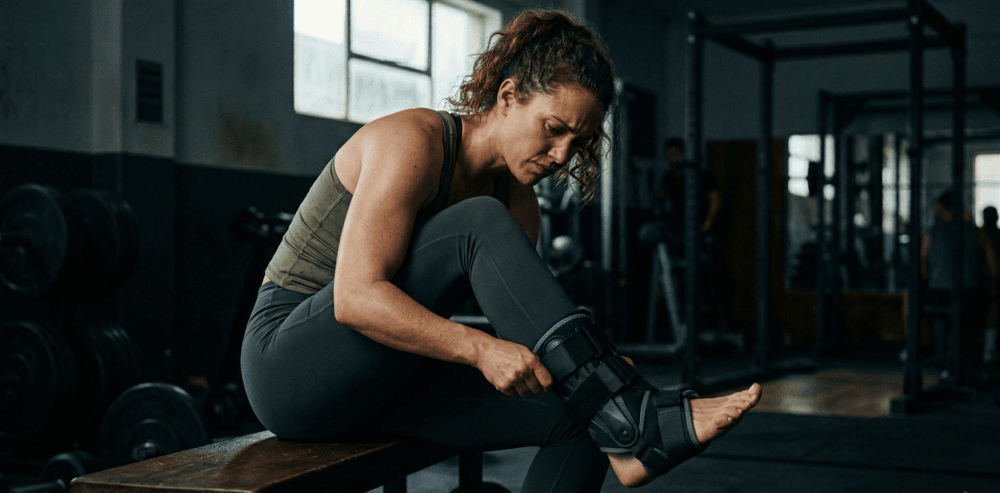
The constant restriction from passive bracing affects more than just comfort. Here’s what the research and our clinical experience point to:
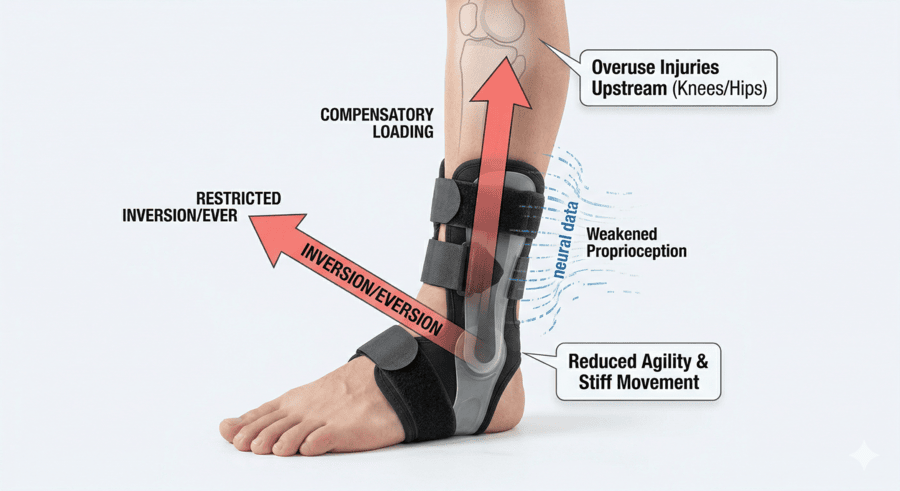
- Reduced agility: Cutting and directional changes require inversion and eversion the same movements traditional braces suppress.
- Weakened proprioception: Over time, relying on a rigid external support can reduce your ankle’s own neuromuscular feedback, making it harder for your body to self-stabilize.
- Compensatory loading: Your knees and hips absorb extra stress when ankle motion is restricted a pattern that leads to overuse injuries upstream.
- Non-compliance: Many patients stop wearing their brace because it feels too limiting, leaving the ankle unprotected entirely.
This is why the type of ankle brace matters just as much as whether you wear one.
Traditional Bracing vs. Adaptive Technology
Ankle bracing has evolved significantly in recent years. Understanding the difference between old and new can change how you approach your foot and ankle care.
Adaptive bracing works on the same principle as a seatbelt — completely unrestricted during normal conditions, but locking instantly when a sudden harmful force is detected. The result is protection only when you need it, and freedom the rest of the time.
How Innovation Is Redefining Ankle Protection
One of the most clinically validated examples of this new approach comes from Betterguards, whose micro-hydraulic piston technology can stabilize the ankle up to 4x faster than the body’s own neuromuscular response. In independent studies, athletes using this adaptive system returned to play 54.4% faster and experienced 62.5% fewer severe ankle injuries compared to traditional bracing methods.
The technology isn’t just consumer hype — Betterguards was selected by the NBA Launchpad program in 2022, validating adaptive ankle stabilization at the highest level of professional sport. At 40% lighter than conventional braces with 27% greater mobility, it represents a meaningful clinical leap for patients who previously abandoned bracing because it felt too limiting.
This kind of innovation is exactly what patients managing chronic ankle instability, post-sprain recovery, or high-demand athletic activity have been waiting for.
Dr. Hymowitz’s Expert Take on Ankle Brace Selection
At City Orthopaedics Sports Medicine, foot and ankle care is guided by Dr. Jason Hymowitz, DPM, DABPM, AACFAS, MS a board-certified podiatric physician with advanced fellowship training in foot and ankle medicine. Dr. Hymowitz brings a precise, individualized approach to every patient who walks through the door with ankle concerns.
“A brace should complement your mechanics, not fight them,” says Dr. Hymowitz. “We look at ankle stability, gait patterns, injury history, and activity demands before making any recommendation. The wrong brace — even a well-made one — can create problems that didn’t exist before.”
Dr. Hymowitz sees patients across City Orthopaedics’ New Jersey locations in East Rutherford, Paramus, and West Orange office. His evaluations go beyond the brace itself — incorporating targeted physical therapy, strengthening protocols, and long-term return-to-activity planning.
Signs It’s Time to Reassess Your Ankle Support
Not sure if your current ankle brace is working for you? Watch for these warning signs:
- You’ve sprained your ankle while already wearing the brace
- Your knee or hip has started aching since you began regular brace use
- You feel noticeably slower when cutting or changing directions
- Your ankle feels unstable or “weak” the moment you take the brace off
- You skip wearing it because it’s too uncomfortable or restrictive
- Your pain or swelling hasn’t improved after weeks of consistent use
Any of these patterns warrants a professional foot and ankle evaluation — not just a switch to a different brace brand off the shelf.
A Smarter Approach to Ankle Health
The right ankle brace is a tool, not a complete solution. At City Orthopaedics and sports medicine, patients receive a comprehensive care plan that combines proper bracing with physical therapy, proprioceptive training, and progressive return-to-activity guidance — all tailored to individual goals and anatomy.
Whether you’re an athlete in Bergen County or Essex County trying to get back on the field, or someone managing daily discomfort in Manhattan, the path to real ankle recovery starts with expert evaluation.
Don’t let the wrong ankle brace be the thing standing between you and your best movement. Book an appointment with Dr. Hymowitz at City Orthopaedics Sports Medicine today — and get the personalized foot and ankle care you actually need.
Frequently Asked Questions
Can wearing an ankle brace cause knee pain?
Yes, it can. Traditional ankle braces that constantly restrict motion may cause your knee to absorb compensatory forces, increasing joint stress over time. If you’ve noticed knee discomfort since starting regular brace use, consult a foot and ankle specialist for a full biomechanical evaluation.
How do I know if my ankle brace is right for my activity level?
The right ankle brace depends on your injury history, activity demands, and ankle mechanics. A rigid brace may suit post-surgical recovery, while an adaptive brace may be better for active athletes. A specialist like Dr. Hymowitz at City Orthopaedics can assess your situation and recommend the most appropriate support.
What is adaptive ankle bracing technology?
Adaptive ankle bracing uses responsive mechanisms — such as micro-hydraulic pistons — to provide support only when the ankle rolls into a dangerous position, then release once the threat has passed. Unlike passive braces that restrict movement constantly, adaptive systems preserve natural motion and reduce performance interference.
Do ankle braces weaken ankle muscles over time?
Prolonged use of overly restrictive braces can reduce muscle activation and proprioceptive feedback, potentially leading to weakness and dependency. This is why bracing should be paired with targeted strengthening and rehab exercises — something City Orthopaedics incorporates into every ankle care plan.
Where can I see a foot and ankle specialist in New Jersey or New York?
City Orthopaedics Sports Medicine has offices in East Rutherford, Paramus, and West Orange, NJ, as well as Manhattan, NY. Dr. Jason Hymowitz, DPM, DABPM, AACFAS, MS, leads foot and ankle care across all locations. Book an appointment online at your most convenient location.
Is it better to tape my ankle or wear a brace?
Both options provide ankle support, but bracing is generally more consistent and practical for regular use. Athletic tape loses effectiveness quickly with sweat and movement, while a properly fitted brace maintains support throughout activity. Dr. Hymowitz can guide you on the best choice for your specific condition and lifestyle.